
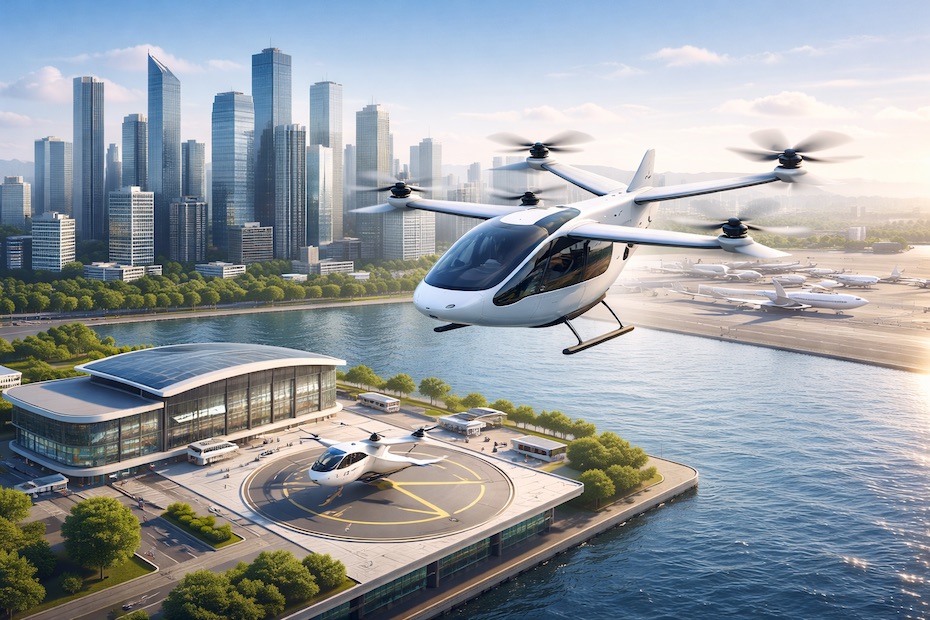
Urban air mobility (UAM) will change city skies by turning short, high-value trips into scheduled, repeatable aerial routes between purpose-built vertiports, using electric vertical takeoff and landing (eVTOL) aircraft that operate under aviation-grade certification, pilot training, and defined operating rules. You should expect the first meaningful shifts to show up as airport-to-city and city-to-city edge links, then scale as infrastructure, dispatch, and noise procedures mature.
You’re going to get a clear, operator-minded map of what matters: how eVTOLs actually work in service (not in renders), what regulators have already locked in, what infrastructure is real versus aspirational, and where the early business models win or break. You’ll also get practical, field-tested decision points you can reuse if you’re building, investing, regulating, or simply planning to ride.
What is urban air mobility (UAM), and how is it different from helicopters?
UAM is a networked transportation system where aircraft behave more like scheduled mobility nodes than bespoke charter flights. You’re not buying “a helicopter flight”; you’re buying a route, a time window, and a service level that has to perform reliably across weather, noise limits, dispatch peaks, and maintenance cycles.
Helicopters already move people in cities, so the difference is not vertical lift. The difference is repeatability at scale: standardized pads (vertiports), higher daily cycle counts, tighter turnaround procedures, and passenger handling that looks closer to premium ground mobility than private aviation. Helicopter ops often succeed with low volume and high flexibility; UAM succeeds with consistent throughput and disciplined constraints.
You’ll also see a different economics stack. Helicopters carry high direct operating costs, heavy maintenance intensity, and community acceptance challenges that get worse as frequency rises. UAM targets lower energy cost per trip, higher dispatch automation, and reduced perceived annoyance through flight profiles and sound characteristics, but it only works when you engineer the entire system: aircraft, vertiport layout, charging, airspace procedures, and staffing.
How do eVTOL aircraft work, and why are “powered-lift” rules a big deal?
An eVTOL uses distributed electric propulsion to generate lift vertically, then transitions to wing-borne flight for cruise (for many designs), then transitions back for vertical landing. Operationally, that means your pilot and procedures must handle at least two very different regimes: low-speed, power-demanding vertical segments and higher-efficiency forward flight.
The “powered-lift” label matters because it defines how you train pilots and how you legally operate the aircraft across those regimes. In the U.S., the FAA issued a final rule that creates and clarifies pathways for powered-lift pilot certification and operating requirements, using a mix of permanent changes and a time-limited SFAR to enable near-term entry into service while data is gathered. The rule became effective in early 2025, and it treats powered-lift as the first new civil aircraft category since helicopters entered the system decades ago.
From an operator’s chair, this is not paperwork trivia. It determines whether you can build a pilot pipeline, what counts for training credit (including simulator strategies), what minimums and visibility requirements apply by phase of flight, and how quickly you can standardize your line operations. If you want eVTOLs to behave like transit, you need rules that make training scalable without compromising safety margins.
When will eVTOL air taxis actually be available in U.S. cities?
You should separate “first flights with paying customers” from “meaningful availability.” The earliest services are positioned to look like premium shuttles: limited routes, strong weather and dispatch constraints, and tight geographic footprints anchored by one or two high-demand corridors (most often airport links).
In the U.S., the gating items are not marketing launches; they’re certification and operational readiness: aircraft type certification, production certification capacity, operator certificates, training approvals, and vertiport readiness. Some companies have already secured key operator-side certifications that allow commercial operations with conventional aircraft while they prepare procedures and staffing for eVTOL entry, and pilot training infrastructure has started to formalize through FAA flight school certification steps. Those pieces reduce “day-one chaos,” but they don’t replace aircraft certification.
Expect availability to expand only when three curves move together: dispatch reliability (including charging turnaround), maintenance predictability at high cycle counts, and community-approved operating procedures (routes, altitudes, and noise management). When those align, you’ll see frequency climb, prices normalize, and more than one vertiport per metro become genuinely useful.
How safe are eVTOLs compared with helicopters and small aircraft?
You should evaluate eVTOL safety the same way regulators and serious operators do: certification basis, failure modes, training, and operational constraints. The selling point is not “electric is safer”; the selling point is designing for redundancy with multiple propulsors, rigorous flight control systems, and structured training and checking built into commercial ops.
In practice, the safety case leans heavily on three elements. First, certified aircraft design standards and compliance testing, including how the aircraft handles loss of thrust, flight control faults, battery thermal risks, and transition edge cases. Second, pilot qualification rules that match the aircraft’s hybrid characteristics, which is exactly why powered-lift training standards and operational rules matter. Third, operational discipline: stabilized profiles, obstacle management, vertiport procedures, and strict go/no-go gates when conditions drift.
If you’re comparing to helicopters, be honest about where helicopters shine: proven dispatch playbooks, mature maintenance networks, and highly experienced pilots. UAM has to earn that trust in the field, route by route, with transparent operational performance. Your best indicator won’t be a brochure; it will be how conservative early standard operating procedures are, how tightly operators manage margins, and how quickly incident learnings propagate into training and software updates.
How loud are eVTOLs, and what will cities do about noise?
Noise is the make-or-break constraint once you scale frequency. You can sell a few novelty flights anywhere; you cannot run hundreds of movements per day over neighborhoods unless residents tolerate the acoustic footprint.
You should think in terms of sound character and operational control, not a single decibel number. Many eVTOL designs aim to reduce the low-frequency “thump” perception associated with helicopters by using different rotor/prop architectures and flight profiles, but you still have intense noise events during takeoff and landing. That’s why vertiport placement, approach/departure corridors, altitude management, and schedule shaping matter as much as hardware.
Cities will manage this the way aviation always has, just with new geometry: published procedures, curfews or time-of-day restrictions, preferential routes, and performance-based constraints. Research programs and surveys on community response to aircraft noise keep reinforcing a basic operational truth: annoyance is not only physics; it’s repetition, predictability, and perceived fairness. If you’re planning UAM operations, design your noise plan as a network policy from day one, not as a late-stage PR patch.
What infrastructure do vertiports need, and where will they be built first?
A vertiport is not “a helipad with a charger.” If you want airline-like consistency, you need engineered surfaces, obstacle protection, markings/lighting, passenger flow, emergency response planning, and electrical capacity that supports high-rate charging and peak utilization.
Regulators and standards bodies have already put real structure behind this. In the U.S., the FAA has published engineering guidance for vertiport design (including updates that treat vertiports as a subclass of heliports and address markings, geometry, and downwash/outwash considerations). In Europe, EASA has published prototype technical design specifications for vertiports, aimed at helping cities and developers plan facilities that fit dense urban constraints and VTOL operating profiles.
Where will you see them first? Existing aviation real estate wins early: underutilized airport areas, general aviation fields, and upgraded heliports, because you inherit zoning, obstacle control, and emergency access. Rooftops and downtown builds come later, after you solve three hard problems: structural load paths and vibration, safe passenger processing in constrained footprints, and reliable grid upgrades without turning every site into a multi-year utility project.
How much will eVTOL flights cost, and who will actually use them?
Early pricing will track premium ground mobility and premium shuttle economics, not mass transit. You’re paying for scarce seats, high pilot labor, conservative maintenance reserves, vertiport staffing, and low initial utilization while the system learns. As utilization rises and turnaround becomes routine, the cost per seat-mile can drop, but only if battery lifecycle, charging time, and dispatch reliability cooperate.
The earliest consistent users are not tourists; they’re time-sensitive travelers whose alternative is a predictable delay: airport commuters, business travelers moving between dense nodes, and certain medical logistics and critical spares movement (where cargo variants often prove operational value sooner). You’ll also see corporate shuttle models where a single buyer aggregates demand and stabilizes schedules.
If you’re building a business case, don’t anchor on a single price point. Anchor on three levers you can measure and control: average load factor, average daily cycles per aircraft, and on-time performance under real weather/ATC constraints. When those metrics stabilize, pricing becomes a strategy choice instead of a survival constraint.
What is an eVTOL air taxi?
- Electric aircraft that takes off/lands vertically
- Flies short routes between vertiports
- Operates under certified aircraft + trained pilots
- Targets fast airport/city trips with lower local emissions
Your next step: plan for operations, not headlines
You’re watching a new aviation segment move from prototypes into regulated service, and the winners will behave like disciplined operators, not gadget launches. Keep your attention on powered-lift operating rules, vertiport standards, pilot pipeline maturity, and noise procedures, because those determine scale. Treat early routes as system tests: charging, dispatch, maintenance, passenger processing, and community tolerance all get validated there. When those pieces lock in, eVTOLs stop being a demo and start becoming an everyday mobility option above your city streets.

Jared Ailstock is Managing Partner at AIP Capital with over 15 years of experience in aviation finance and investment. He specializes in global aviation strategy, asset-backed transactions, and sustainable growth across the aerospace industry.